




Designing for Reality: Why Engineering Systems Fail When Imported Without Local Context
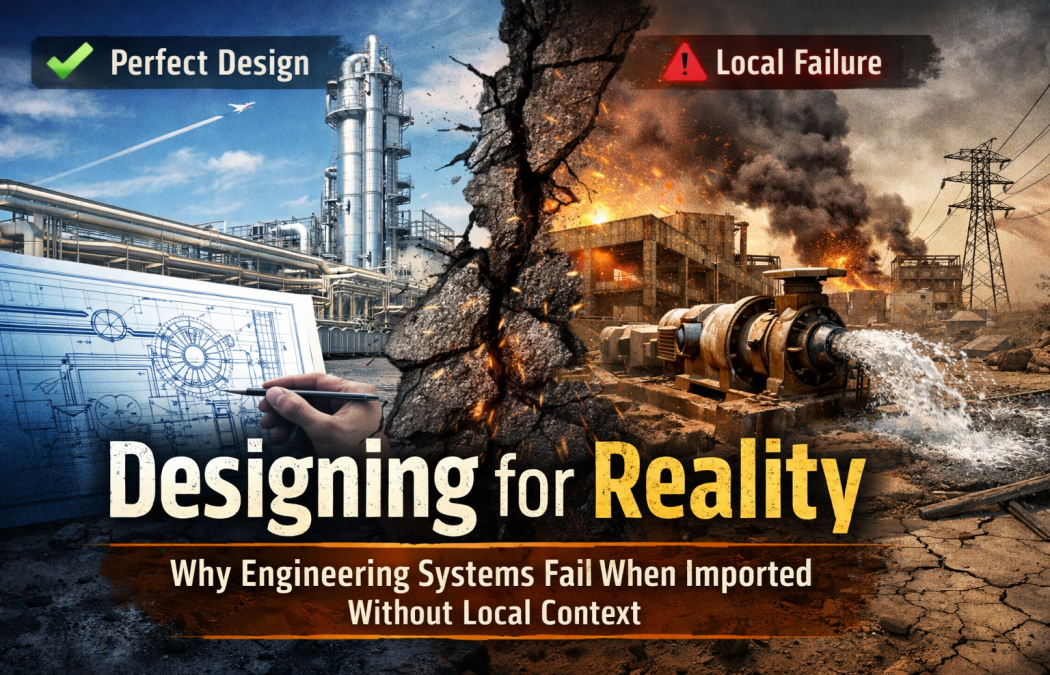
Most engineering systems don’t fail because they were poorly designed.
They fail because they were designed for a place that doesn’t exist.
On paper, the system was perfect.
In reality, it was dropped into a completely different environment — and expected to behave the same.
That gap between design assumptions and operating reality is where most industrial failures in Africa begin.
The Comfort of “Proven Designs”
Imported systems come with confidence.
They’ve worked in Europe.
They’ve worked in North America.
They come with manuals, certifications, and impressive references.
So engineers assume:
“If it works there, it will work here.”
That assumption is expensive.
Engineering success is not about where a system worked before — it’s about where it must work now.
The Local Conditions Most Designs Ignore
Many systems are designed around ideal conditions that rarely exist in emerging markets.
1. Power Supply Is Not Stable
Designs often assume:
- Clean voltage
- Minimal fluctuations
- Rare outages
Reality:
- Frequent power dips
- Sudden surges
- Generator changeovers
Result:
- Burnt motors
- Failed control panels
- Shortened equipment life
2. Water Quality Is Highly Variable
Design assumptions often use:
- Stable raw water parameters
- Predictable contamination levels
Reality:
- Seasonal changes
- High turbidity after rainfall
- Industrial and domestic pollution
Result:
- Overloaded filters
- Rapid membrane fouling
- Inconsistent output quality
3. Maintenance Is Not Always Predictable
Many systems assume:
- Strict maintenance schedules
- Skilled technicians always available
- OEM parts on hand
Reality:
- Delayed maintenance
- Limited spare parts
- Technicians managing multiple systems
Result:
- Minor issues become major failures
- Systems run outside safe limits
- Downtime becomes routine
When “Efficiency” Becomes Fragility
Imported designs often chase maximum efficiency.
Higher pressures.
Tighter tolerances.
Complex automation.
In harsh environments, efficiency without resilience is weakness.
A slightly less efficient system that can survive power spikes, poor water quality, and delayed servicing will outperform a “perfect” design that collapses under stress.
Common Failure Patterns Engineers See Too Late
These failures don’t happen suddenly.
They follow a pattern:
- Equipment works well at commissioning
- Performance slowly drops
- Operators compensate manually
- Breakdowns increase
- Management blames operators
The real issue?
The system was never designed for their reality.
What Designing for Reality Actually Means
Designing for local context is not about lowering standards.
It’s about changing priorities.
1. Design for Abuse, Not Ideal Use
Assume:
- Voltage instability
- Operator intervention
- Inconsistent inputs
Build systems that can survive it.
2. Prioritize Simplicity Over Complexity
Simple systems:
- Are easier to maintain
- Fail more predictably
- Recover faster after faults
Complex systems fail quietly — until they don’t.
3. Build Maintenance Into the Design
Design questions engineers must ask:
- What happens if servicing is delayed?
- Can this component fail safely?
- Are spare parts locally available?
If the answer is no, the design is incomplete.
4. Localize Critical Components
Not every component must be imported.
Local fabrication, adaptation, and redundancy often:
- Reduce downtime
- Improve response time
- Extend system life
The Engineer’s Responsibility Has Changed
Today, engineering is no longer just about calculations and drawings.
It is about:
- Understanding operations
- Predicting misuse
- Designing for human and environmental realities
The best engineers are not those who design perfect systems —
but those who design systems that keep working when conditions are imperfect.
Reality Is the Ultimate Client
Nature does not read design manuals.
Power grids do not respect specifications.
Operators do not behave like flow diagrams.
If a system only works under ideal conditions, it is not engineered — it is imagined.
Design for reality, or reality will redesign your system for you — brutally and expensively.