




Corrosion, Scaling, and Fouling: The Silent Enemies of Oil, Gas, and Water Infrastructure
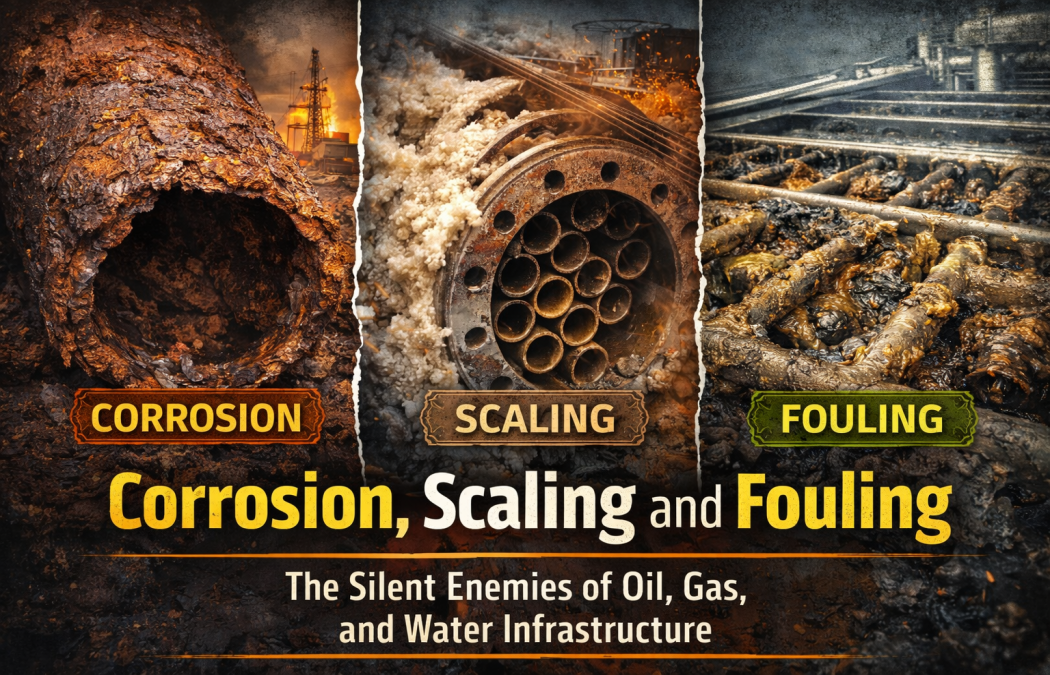
They don’t announce themselves.
They don’t trip alarms on day one.
They don’t cause dramatic failures — at first.
Yet corrosion, scaling, and fouling quietly destroy more infrastructure in oil, gas, and water systems than accidents, overloads, or poor design ever will.
By the time the damage is obvious, the system has already been losing the fight for years.
Why These Enemies Are So Dangerous
They work slowly.
They hide inside pipes, heat exchangers, membranes, pumps, and tanks.
They give the illusion of normal operation — while performance is being eaten away from the inside.
Most plants don’t fail suddenly.
They fade.
And these three are usually responsible.
Corrosion: When the System Eats Itself
Corrosion is not just rust.
It is a chemical conversation between your infrastructure and its environment — and the environment usually wins.
How Corrosion Really Starts
- Water chemistry shifts
- Oxygen finds a way in
- Protective coatings fail
- Dissimilar metals are joined without isolation
At first, nothing seems wrong.
Then:
- Wall thickness reduces
- Leaks appear where none existed
- Structural integrity quietly disappears
By the time corrosion is visible, the real damage is already deep.
Scaling: When Efficiency Is Choked, Not Broken
Scaling is deceptive.
The system still runs.
The pumps still turn.
The heat exchanger still transfers heat — just badly.
Scaling forms when dissolved minerals:
- Precipitate out of solution
- Settle on surfaces
- Harden into stubborn layers
The result?
- Reduced flow
- Increased energy consumption
- Poor heat transfer
- Higher operating costs
Nothing is “broken.”
Everything is wasting money.
Fouling: When Biology and Dirt Take Control
Fouling is the most underestimated of the three.
It comes from:
- Organic matter
- Microbial growth
- Oil residues
- Suspended solids
It builds unevenly, unpredictably, and often aggressively.
Fouling:
- Blocks membranes
- Coats sensors
- Disrupts control systems
- Turns precision equipment into guesswork
Operators start adjusting.
Instruments start lying.
Decisions start being made blind.
Why These Problems Thrive in African Operating Conditions
These enemies love environments where:
- Water quality fluctuates
- Maintenance is delayed
- Power is unstable
- Systems are pushed beyond original design limits
Imported designs often underestimate:
- High mineral content in raw water
- Seasonal variability
- Harsh temperatures
- Limited chemical control
So corrosion, scaling, and fouling are not exceptions — they become normal.
The Early Warning Signs Most Teams Ignore
The system tells you — quietly.
- Energy bills slowly rise
- Pressure drops increase
- Chemical consumption climbs
- Cleaning frequency shortens
- Performance metrics drift
Each sign is small.
Together, they are a warning.
Most teams adjust operations instead of addressing the root cause.
That is how silence turns into failure.
Why “We’ll Clean It Later” Is a Dangerous Strategy
Cleaning is not prevention.
It is damage control.
Each cleaning cycle:
- Removes protective layers
- Stresses materials
- Shortens equipment life
Without addressing the underlying chemistry, flow conditions, and materials selection, the problem always returns — faster and worse.
Designing Systems That Fight Back
These enemies cannot be eliminated.
But they can be managed.
Effective systems:
- Control water chemistry proactively
- Use compatible materials
- Maintain proper flow velocities
- Design for easy inspection and cleaning
- Monitor trends, not just alarms
This is not advanced technology.
It is disciplined engineering.
The Maintenance Trap No One Talks About
As fouling, scaling, and corrosion increase:
- Maintenance becomes more frequent
- Downtime increases
- Spare parts disappear faster
Soon, the system exists to maintain itself — not to serve its original purpose.
That is when management says:
> “This plant is too expensive to run.”
No.
It was allowed to decay silently.
The Real Cost Is Not Replacement — It’s Trust
When systems underperform:
- Operators lose confidence
- Management loses patience
- Investors lose trust
Infrastructure that cannot be trusted becomes a liability — even if it is technically still running.
Silence Is Not Safety
If corrosion is visible, you are late.
If scaling is obvious, efficiency is already gone.
If fouling is severe, control has already been lost.
The most dangerous failures are the ones that stay quiet — until they are irreversible.
In the next article:
We’ll expose why most monitoring systems fail to catch these problems early — and how to design indicators that actually warn you in time.
Because in oil, gas, and water infrastructure,
what you don’t hear is often what destroys you first.